Showing posts with label David Beckham. Show all posts

Friday, January 08, 2016

The History of the Replica Football Shirt


A replica football shirt is defined as an (official) copy of a kit. It is a huge business in the United Kingdom.

Though replica shirts have been produced since the late 1950's, they were initially marketed only to children, and sold as part of a full playing strip. Kit designs were also not copyrighted and at times different clubs, such as Derby County and Spurs, wore identical outfits and different manufacturers produced the same designs.

In the good old days any old red shirt could indicate that you were a Liverpool or a United fan. A dark blue would indicate either Everton or Chelsea.

There were only certain teams which deviated - Arsenal had those white sleeves and Blackburn Rovers played in their blue and white halved shirts.
But then things began to change!

At Coventry City, Jimmy Hill realised the kit was something more than just a uniform to wear on the pitch and he introduced the first ever kit of just one colour (other than white) as they changed from their hitherto mostly dark blue shirts with white shorts to a kit of all sky-blue. Bill Shankly only adopted all red for his Liverpool side in 1965-66 - three years after Coventry's all sky-blue affair (below).


Moving into the 1970's Bert Patrick who was the chairman of Admiral (top right), a Leicester-based knitwear firm, spotted an opportunity to produce football teams’ kits in exchange for prominent branding on the shirts, plus exclusive rights to sell the replica versions to fans.

Leeds United, who had changed from their traditional colours of blue and gold to all white in the early 1960's, became the first club to offer their fans the chance to buy replica kits in 1975 as part of their deal with kit supplier Admiral. When Don Revie left Leeds to take over as England Manager the national team entered into a similar arrangement with Admiral.

When Bert Patrick's Leicestershire knitwear company Cook and Hurst, started producing the official England football kit using the trade name ‘Admiral’ - they became the first to include the manufacturer's logo on the chest - and in 1974 he paid the Football Association £16,000 a year for the privilege. England’s traditional plain white shirt was suddenly adorned with red-and-blue sleeve stripes and a yellow logo, much to the horror of traditionalists and to the delight of schoolboys across the nation.


That shirt was the must-have item of 1975, and when Manchester United were also signed up, Admiral had the ‘Big Three’. The rest quickly fell into line. The revolutionary deal allowed Admiral to sell British-made replica shirts to supporters for £5 - increasing to £9 with shorts and socks included.

Now Nike, the current England kit manufacturer, have a £25 million sponsorship deal with the Football Association, and charges fans around £90 for a replica shirt.

Nike also currently represent the England national women's football team too (right).

Between 1975 and 1980, use of different coloured trim on shirts increased by 40 per cent, and manufacturers’ logos soon became ubiquitous.

The Admiral agents had an eye for an opportunity. When Southampton beat Manchester United in the 1976 FA Cup Final both teams wore an Admiral strip that had been designed and manufactured since their semi-final victories, and the multiple logos down sleeves and shorts were exposed to a huge global TV audience.

In the last 25 years, the percentage of clubs changing their home kit at the start of any season has doubled to almost 100 per cent.

Things really took off when Liverpool became the first club to wear a sponsor's name on their shirts following their 1979 deal with Japanese electronics manufacturer Hitachi (right).

Replica shirt sales are important to both sponsors and clubs. In the 1980's, when hooliganism was a factor, club replica shirt sales were quite low and clubs did relatively little to limit the use of official club logos.

Despite Admiral's innovative deals, by the start of the 1980's the competition from the Far East had become too much and Patrick, faced with low profits which were dwindling into losses, was forced to close his factories in Wigston, Leicestershire. Admiral was bought up by a Dutch oil company called, Frisol. By 1984, England had a new kit manufacturer, Umbro.

In 1990, following the National League Baseball Association example, Arsenal were one of the first clubs to register its name, to stop traders outside the football ground selling the club logo at an undercut price (Hallam, 1992).

Following this and the launch of the new FA Premier League in 1992, the League and all individual clubs now jealously protected 'official' club and League products from reproduction or imitation by non club producers.

Today, as the game has rid itself of the 'hooliganism' tag and wearing club shirts has become fashionable, effective licensing deals are crucial to commercial success. All top clubs now have extensive club shops or superstores selling exclusive official club merchandise.

The market for replica shirts has grown enormously, with the revenue generated for leading clubs and the frequency with which they change designs coming under increased scrutiny, especially in the United Kingdom, where the market for replicas is worth in excess of £200m.

Several clubs have been accused of price fixing, and in 2003 Manchester United were fined £1.65m by the Office of Fair Trading. The high prices charged for replicas have also led to many fans buying fake shirts which are imported from countries such as Thailand and Malaysia.
Nonetheless, the chance for fans to purchase a shirt bearing the name and number of a star player can lead to significant revenue for a club.

In the first six months after David Beckham's transfer to Real Madrid in 2003 the club sold more than one million shirts bearing his name.

When Newcastle United signed Alan Shearer (below) in July 1996, the North-East club made £250,000 on the day of his signing, just in terms of Shearer replica shirt sales. 


When Inter Milan, in contrast, signed Ronaldo in 1997, the club had prepared no shirts carrying the Brazilian's favoured No.9. Instead, counterfeit No.9 shirts appeared to satisfy local demand, forcing the club to play their new star as a No. 10 in order to cash in later on official shirt sales!

The adult market for replica football shirts as leisurewear only developed significantly from the late 1980s and early 1990s. Today sales to adults provide the bulk of a billion dollar industry, Manchester United alone selling approximately 2 million shirts per year.


Top selling player shirts (as at 30/09/2015):

10/ Philippe Coutinho (Liverpool/Brazil)

9/ Alexis Sánchez (Arsenal/Chile)

8/ Sergio Agüero (Manchester City/Argentina)

7/ Neymar (Barcelona/Brazil)

6/ Wayne Rooney (Manchester United/England)

5/ Eden Hazard (Chelsea/Belgium)

4/ Bastian Schweinsteiger (Manchester United/Germany)

3/ Memphis Depay (Manchester United/Netherlands)

2/ Cristiano Ronaldo (Real Madrid/Portugal)

1/ Lionel Messi (Barcelona/Argentina)


# Information courtesy of kitbag.com


Tuesday, December 01, 2015

Babe of the Month - Gorgeous TV presenter and model Layla Anna-Lee


Layla Anna-Lee was born on 22nd March 1983 in London, England.

Layla is an English TV presenter, host, model and actress, best known as the voice of the London 2012 Olympic Games Opening Ceremony, broadcast live to an audience of nearly one billion. She also hosted the London 2012 Olympic Beach Volleyball Finals.

That same year Layla hosted the Queen's Diamond Jubilee party live in front of 20,000 people in Trafalgar Square.

Layla has hosted 'OK! Insider,' since its launch in 2008, presenting red carpet events and interviewing celebrities for the magazine's website. In 2010, she became the face of  'OK! Magazine Online,' and has interviewed cast members of the Twilight movies, actor Harrison Ford, and fashion designer Vivienne Westwood, as well as covering 'Big Brother' series eleven in 2010, which lead to her appearance on 'Big Brother's Little Brother.'

Having presented the Goal Line show on Goal.com, Layla was headhunted by MLS's 'KickTV' and hosted their weekly show 'The Rumour Mill' before hosting 'KickTV’s' journey to the Confederations Cup in 2013.

In 2014 Layla returned to Brazil for the World Cup for 'KickTV.' Whilst in Rio the views on Layla’s videos helped 'KickTV' reach their 100 million viewer milestone. During the World Cup Layla also hosted adidas' live World Cup show 'The Dugout' - where she interviewed many legends of the game such as David Beckham, Kaka and Ruud Gullit.

Layla continues to work with the brand fronting their Champions League show 'adidas GameDay+,' currently the most popular football show online.

Layla has also worked for Eurosport and Sky Sports covering major road cycling events and mountain biking.

Layla has continued to interview many footballing legends including a rare interview with Lionel Messi, Gareth Bale, Pep Guardiola and Luis Suarez.

Since 2013, she has co-presented 'The Munch Box,' a Saturday morning children's cooking show alongside Ben Ebbrell and then Joe Hurd for ITV and CITV.

An accomplished writer, Layla attended the London School of Journalism and regularly writes for the Huffington Post. She is an avid Crystal Palace fan and has a regular column in the Crystal Palace official match day programme under the appellation 'Layla The Eagle.'

Layla speaks French, Spanish and Portuguese and can be seen on 'BBC Bitesize,' helping children learn French. She has also modelled for Max Factor, Daewoo, Samsung, Bacardi, First Choice Holidays, Harvey's and Kinder Bueno.

In 2013 Layla was named in FHM’s 100 Sexiest Women in the World and appeared in an exclusive interview and photo shoot for a 6-page FHM feature in their April 2013 edition. In 2012 she made Time Out’s Hot 100 – a prestigious list of the most influential creatives in Great Britain.


You can follow Layla on Twitter, Facebook and Instagram

Monday, October 08, 2012

The Best Selling Replica Club Shirts in the World


A German sport market research company, has released a very interesting survey on the world’s best selling club football shirts.

Dr Rohlmann’s and his PR Marketing team focused on the sales period 2007/8 to 2011/12 inclusive, in order to have the most accurate overview.

Not suprisingly the survey found that Manchester United and Real Madrid are the two clubs selling the most replica shirts with both United and Madrid averaging 1.4million shirts sales globally each year in the past five years !

As the graphic below shows, Barcelona are No.3 on the sales list (Nike, average 1.15m sales a year) followed by Chelsea in fourth place (adidas, 910,000). The top ten also includes Bayern Munich (adidas), Liverpool (adidas during the research period, now Warrior), Arsenal (Nike), Juventus (Nike), Inter Milan (Nike) and AC Milan (adidas).

Chelsea are the most significant ‘climbers’ since detailed market statistics were last published by this site two years ago. They were adidas’s joint-second best sellers with Liverpool and Bayern Munich two years ago, but have moved clear into second place for adidas – and fourth overall – now!

Dr Rohlmann pointed out that "Oscillations are normal because any sporting success or lack of success drives shirt sales, sometimes up, sometimes down, as does the acquisition or sale of particular stars."
For example, in the case of Chelsea, there was a 2011/12 uplift, undoubtedly as a result of their success in the UEFA Champions League. A second example of this would be at Bayern Munich. Bayern sold between 1million and 1.5million replica kit shirts in 2011/12, when Bayern reached the Champions League final (against Chelsea), which was played in their own stadium in their home city of Munich. A third and final example of success increasing shirt sales could be allied to Olympique Marseille. Their average replica shirt sales over the last five seasons is about 350,000 per year. But if you refer exclusively to the 2009/10 season, when they won the French championship, adidas sold nearly 500,000 replica shirts."

Premier League winners Manchester City sold somewhere just over 250,000, but their five-year average is 175,000 per year – sufficient only to place them 17th in Europe.

However, it is important to remember the results of the survey are based solely on the the volume of replica shirts sold and does not include other official club merchandise, such as training kit, jackets, bags, caps, towels, calenders e.t.c.

If the survey were to include all licensed merchandise sold by football clubs, then Liverpool would be ahead of Real Madrid. Liverpool are adidas’s top-selling team in terms of sales of overall merchandise.

The official Manchester United Investor Relations website says that "over five million items of Manchester United (Nike) branded licensed products were sold in the last year, including over two million Manchester United jerseys." Dr Rohlmann says that for 40 per cent of all United merchandise to be shirts "is extremely high compared to other top European football clubs."

The market research looked in particular at the major European leagues (La Liga, Barclays Premier League, Serie A TIM, Ligue 1 Orange, Bundesliga). However the PR marketing team also looked into big clubs in "less powerful leagues" to assess their value. The conclusion was that no other club in any other European league came close to matching the sales of the top ten listed clubs.

First and foremost, the richest football clubs have the marketing power to create, market and sell their football shirts. Secondly, the power of the domestic league is also a crucial element.

Out of the top 10 teams, four came from the English Premier League: Manchester United, Arsenal, Liverpool and Chelsea, three from Seria A: Inter Milan, AC Milan and Juventus, two from La Liga: FC Barcelona and Real Madrid and one from the Bundesliga: Bayern Munich.

Galatasaray and Fenerbahce, 'the big hitters' of the Turkish Super Lig, both adidas teams, have a huge amount of local and global fans. However their replica shirts sales would amount to a lesser number than the 10th highest ranked club. Another element to consider is the amount of counterfeit clothing products coming out of from Asia and Turkey. This has a very damaging effect on club sales of official merchandise in the less glamorous and affluent leagues.

A 'big' club like Ajax Amsterdam, an adidas club, in a 'small' league like the Dutch Eredivisie league might expect to sell 100,000 shirts and probably fewer in most seasons. Glasgow Celtic, a Nike club are believed to be the biggest sellers among Scotland’s clubs, with 'good year' sales at the lower end of the top 10, ie: several hundred thousand per year, many of them overseas in North America, Canada and Australia. This is still somewhat less than the likes of AC Milan or Inter which sell an average of 350,000 to 425,000 units per calender year.

Source: Dr Peter Rohlmann, www.pr-marketing.org/  and http://www.sportingintelligence.com


When it comes to sporting the name of their favourite Premier League player on the back of a replica shirt, Manchester United striker Wayne Rooney is officially the most popular choice of fans around the world.

Global sales data from Sporting iD, who determined the top five by the number of player names sold for official replica shirts, said it was a close race for the top three positions.

Rooney edged out Liverpool's Steven Gerrard and Chelsea frontman Fernando Torres, Cristiano Ronaldo, formerly with Manchester United and now with Real Madrid, is the fourth most popular over the 20 seasons of the Premier League, with Chelsea's Frank Lampard fifth.

Sporting iD global sales and marketing director Rob Thayne said: "We first started producing Rooney's official player identity in 2002, after he made his professional debut with Everton at the age of 16. We then had to expand that production greatly following his move to Manchester United in the summer of 2004. But Rooney truly went into a league of his own in 2007 when Ruud van Nistelrooy vacated the Manchester United number 10 shirt, and there is a global demand that shows no sign of abating."


Rooney is the first United player to lead the list since Cristiano Ronaldo in the 2007/08 season. But one name could have beaten Rooney to the award. "Had David Beckham remained in the Premier League then the list might have looked different. Certainly his move to Real Madrid in the summer of 2003 triggered record sales of 'Beckham 23' shirts, and before him Eric Cantona was a best seller in the 1990's," said Rob Thayne.

Source: Data supplied by www.sporting-id.com

Sunday, July 08, 2012

The Biggest Football Boot Sponsorship Deals & which boots the stars wear!


Football boot sponsorship deals provide lucrative ‘additional’ income to those at the top of the game. Becoming the face of a brand’s footwear also opens up other avenues for big name players, such as money-spinning contracts in other associated domains such as clothing, men’s grooming, television and billboard advertising as well as promotional events.

Here I take a look at which football superstars earn the most for sporting a particular brand's boot.
These are the Biggest Football Boot Sponsorship Deals in the game today – read it and weep!

Wayne Rooney (Manchester United) - Nike - £1 million per season

At £1m a season, Wayne Rooney has one of the biggest deals with arguably the biggest sports brand on the planet. Despite the controversial England striker having a far from squeaky-clean image, the Manchester United star is the face of the Nike T90 Laser IV boot. Only last April he lost his £600,000 a year endorsement with Coca-Cola after a foul-mouthed outburst was seen by millions on television, as he screamed the F-word into a camera after scoring a dramatic hat-trick against West Ham. Despite this Nike have stood by their man and Rooney is relied upon by the company to shift their boots by the bucket-load!


The Nike T90 Laser IV (above) has been designed to offer ultimate precision and power. Its adaptive shot shield technology is divided into 'Power' and 'Swerve' zones. The upper region, or the strike zone, is designed to flex naturally with the fit as you contact the ball while giving you some added power. The lower region, or swerve zone, features fins that are strategically positioned and sized to allow for closer feel on the ball while supplying added bend when you need it. Both zones are designed to flex naturally with ball contact, allowing natural movement of the foot.


Sergio Agüero (Manchester City) – Puma – £1.25 million per season

Since landing in Manchester from Madrid in the summer of 2011 Agüero became an instant hit in the English Premier League, scoring goals regularly and helping Manchester City to win the Premier League title in May in dramatic fashion, scoring the winning goal in the final minute on the last day of the season. Last September Aguero became a landmark signing for Puma’s rapidly expanding stable of football stars, on a massive four-season deal, after persuading him to quit Nike. The Argentine international will become a 'central' figure in Puma's forthcoming global marketing campaigns over the coming years, wearing Puma's line of football boots for a long-term period, beginning with the Speed v1.11.

The Speed v1.11 boot (above) does exactly what it was designed to do when on the pitch, that is, it makes you quicker. However, speed isn’t the only advantage you gain by wearing a pair of these. There is a noticeable increase in power during shooting, which is made possible by the large lace cover. This piece of fabric helps focus all the strength and speed of the player into the centre of the ball, allowing for maximum shot power. The lace cover is held down by an elastic strap and a TriHook fastener to ensure a snug fit. The curved instep of the shoe also helps for a curved shot from both long and close range - an ideal factor for any striker.


Lionel Messi (Barcelona) – adidas – £2 million per season

The best player in the world is only fourth on this list – how does that work? Thankfully for adidas, the contract with the two-time FIFA Balon D'or winner arranged his football boots deal back in March 2006, before his ascent to mega-superstardom, so adidas have been paying relatively little to have Messi in their wildly-popular adidas F50 adiZero range.


The adidas F50 adiZero miCoach boot (above) has taken footwear in the sport to a new level. Last November it was revealed that the Barcelona superstar had spent months developing the world’s first intelligent football boot with manufacturers adidas. It records player-specific data with an innovative miCoach Speed Cell chip placed in the cavity of the outsole. The boots – which store data including: speed, average speed, maximum speed, number of sprints, distance, distance at high intensity levels and active time for up to seven hours after a match or training – transmit on-pitch information to tablets, PCs and Macs using a wireless link.

Visit the adidas Football Bootroom

Cesc Fabregas (Barcelona) – Puma – £3.2 million per season 


Another one of big-spending Puma's massive recent signings is Barcelona midfielder Cesc Fabregas, who has has turned his back on Nike in order to sign a lucrative £16 million boot deal with sportswear giant Puma. After rigorous testing, Fabregas decided last September that he will be sporting the brand-new Puma PowerCat 1.12 boots (below). The 25-year-old former Arsenal captain put pen to paper on a five-year contract and Fabregas will be the flagship player for the PowerCats. As a result the midfield maestro - a member of Spain's double UEFA European Championship and FIFA World Cup winning team, jumps into the top three on the list of the Biggest Football Boots Sponsorship Deals.


The PowerCat 1.12 features the new PUMA 3D DUO Power Shooting Technology, applied to the kicking area on the inside of the boot. Made from an innovative thermoplastic material with two different degrees of hardness, the boot has the advantage of being both highly responsive with extremely high rebound properties. The newly created PUMA 3D PST DUO technology enables improved grip on the ball through its exposed elements, and instead of absorbing the energy it increases the kicking power of the player. The kicking area employs a soft K-Leather while the lightweight microfiber material in the lateral quarter supports the midfoot and helps to keep the weight of the boot to a minimum.


Cristiano Ronaldo (Real Madrid) – Nike – £5 million per season

Cristiano Ronaldo signed a whopping £20 million deal with Nike and stands to rake in £5 million-a-year. The deal negotiated in 2010 (the same year the first Nike CR Mercurial was launched) instantly rocketed Ronaldo into the upper echelon of sponsored athletes in any sport. As well as the face of their Mercurial line of Football Boots, for their money Nike are also getting a player with power, tricks, a signature style of free-kick and model good-looks. Despite technically being less successful at Madrid than at Manchester United, Nike will be banking on the Portugal international to constantly be challenging for titles with Los Blancos before his contract expires.

The Real Madrid forward is an advocate of Nike's Mercurial range and netted an incredible 53 times last season - including 25 times with his right boot and nine with his left. Designed for global icon Cristiano Ronaldo, the Nike Mercurial range of boots are the pinnacle of one of the most technically advanced, innovatively designed football boots ever created. Ronaldo is the heartbeat of every football boot Nike Mecurial produce.

On 24 February 2010 at a Nike Football event in London, Cristiano Ronaldo launched the second release of the Mecurial Vapour Superfly series.

On 16 March 2011 Nike unveiled the third incarnation of the Superfly series – the Mercurial Vapor Superfly III. The Mercurial Vapor Superfly III received its official on-pitch debut on 19 March 2011, when Cristiano Ronaldo and Mesut Özil played in the Madrid derby.

On 14 April 2011, Nike revealed the Nike CR Mercurial Vapor Superfly III (below), a version of the Mercurial Vapor Superfly III to be worn 'exclusively' by Cristiano Ronaldo. Whilst not featuring any technical updates to the standard Superfly III, the Nike CR Mercurial Vapor Superfly III featured an all-over 'Safari' print, that was designed specifically for Ronaldo, an all-over leopard-skin print in black and white, with contrasting safety-vest orange Nike Branding. The concept being that it set the man and the boot apart from the competition! The major innovation for the Superfly II soccer shoes was the development of the Nike Sense adaptive traction technology. A revolution in boot technology, Nike engineered a boot that combines a unique one-piece upper with a traction configuration sole-plate. Designers created an adaptive stud that can extend and retract by up to 3mm, based on ground conditions and pressure exerted by the player. Next-generation Nike Flywire technology was incorporated into the boot’s streamlined upper to provide a unique lightweight, strong and more dynamic fit.


On March 19, 2012 the Nike Mecurial Vapour VIII boot (below) was released. The special features of the boot is that Nike no longer uses the sense studs and 4 studs for the heel counter now Nike uses a whole new stud design for traction and 2 studs for the heel counter. This implant of the Mercurials do not include a carbon fibre soleplate, but instead uses the fibreglass soleplate Nike has been using for 2 years for the standard Vapors. Nike no longer uses Flywire but uses a thin layer of microfibre that has a suede finish, which is said to be for control. Ronaldo currently wears The Vapor VIII, but it was not designed and marketed exclusively for him. Other players that wear the boot include Juan Mata, Neymar, Andrey Arshavin and Mesut Özil.


David Beckham (LA Galaxy) – adidas – £7 million per season

You just cannot keep this man down. David Beckham will forever by synonymous with Adidas, having signed his first deal with the sportswear manufacturers early on in his playing career. The former England captain still wears adidas predators and has a unique deal in which he gets a cut of every boot sold. Beckham's deal with adidas is the result of some shrewd negotiation by 'team Beckham.'


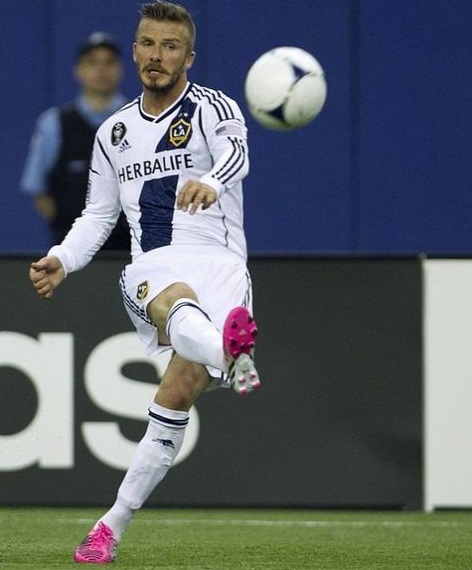
Currently he can be seen wearing adidas Predator LZ DB (above and below), in a white, pink and black colour combination. The Predator LZ marks the first time that adidas have been able to incorporate so many Predator elements into a single boot, thanks to the new Hypertouch synthetic material used for the upper. Soft rubber ribs on the forefoot vamp use a recessed surface to create a ‘vacuum’ effect for a great first touch. SL Rubber on the instep toe area for a ‘high risk/high reward’ combination of spin and power when striking the ball. Finally rubber ‘Ribs’ on the medial out-step provides a precise ‘second skin’ feel when dribbling. The LZ is also the first adidas Predator to feature miCoach technology, with the latest Predator compatible with the same Speed Cell as the F50 adiZero and adiPure 11pro, thanks to it’s modified SprintFrame design.


The LA Galaxy midfielder pockets a percentage of every pair of Beckham-branded adidas football boots or piece of training apparel he personally endorses.

Given the desirable designs often reserved for these items, it’s no surprise to see Beckham pocketing more than any other footballer with his Football Boots Sponsorship Deal.


# Figures correct up to the end of 2011/12 domestic football season.

Saturday, June 23, 2012

Sporting Rich List and Why Women 'Pay' Second Fiddle in the Earnings Ladder


Being a top sportsperson is a sure fire way to get rich!

This week Forbes magazine published a list of the 100 highest paid athletes of 2012, which pretty much confirmed that theory. Let’s now analyse the results, focusing on which athletes and what sports are represented in this inventory of sportspeople with money to burn!

What struck me first was not the obscene amount of money that these professionals earn, rightly or wrongly, for basically doing a ‘job’ they love, but that of the top 100 highest paid athletes, only two of them were women.

Let’s not massage the facts and figures, but without a doubt there is still an irrefutable disparity in remuneration, both in wages and sponsorship, for successful women.

In a nutshell what I am saying is that in the last twelve months, of the top 100 highest paid athletes in the world, only two women had the earning power that has allowed them to dip their toes into the elite pool of sports highest grossing incomes.

Both these female athletes are tennis players.
Maria Sharapova (below right) was 26th overall ($27.9m) and China’s Li Na (right) was 81st ($18.4m). Sharapova, the current French Open champion has long had a coveted portfolio of sponsors that now includes Nike, Head, Samsung, Tag Heuer and Evian. Sales for the Maria Sharapova Collection, her line of products at Nike subsidiary Cole Haan, doubled last year.

Despite the increase in television coverage of women’s sports such as football, rugby and cricket, the gulf in earnings is huge. In the day-to-day workplace it is mainly men who occupy the boardrooms, salaries are disproportionate worldwide and sportswomen are likely to earn less than sportsmen for the foreseeable future, because the market rewards what it considers to be the ‘entertainers’ – men!

It’s the way of the world, but it really hits home when you view the Forbes list and see it for yourself, in black and white.

Turning to the list and identifying criteria among the top earners is actually not as blindingly obvious as one might have at first anticipated.

Athletes from 11 different sports qualified for the top 100. The world's highest-paid athlete is in jail. The guy in second place just lost a world title fight, and the man who held the distinction for a decade is now third.

Tiger Woods has lost his top position, which he had held since 2001, dropping to third place behind boxers Floyd Mayweather Jr and Manny Pacquiao (pictured right). Mayweather fought only two fights in the last year. He spent less than one hour in the ring to dispatch his two foes. His combined payday for the bouts: $85 million. Mayweather maximizes his earnings by acting as his own fight promoter through his company Mayweather Promotions. He collects all of the revenue from tickets, pay-per-view and sponsorships and covers the costs, including the purse for his opponent.
Mayweather is currently serving a three-month jail sentence in Las Vegas for domestic battery.

Pacquiao ranks second with earnings of $62 million. Over the past 12 months he fought Juan Manuel Marquez and Tim Bradley. The bouts netted him $56 million, despite Pacquiao losing his WBO welterweight title to Bradley just a few weeks ago. Pacquiao’s earnings also include money he gets from their broadcast in the Philippines. He also made an estimated $6 million over the past year outside the ring through endorsements. Pacquiao was only ranked 24th last year with $25 million, as he only had one fight during that period and Mayweather was even lower on the list.

Woods’ total earnings dropped $16 million from last year to $59.4 million and have been sliced in half since their peak in 2009. Woods last won a Major in 2008, but despite an increase of $2m in prize money won on the golf course in the last twelve months by Woods, it does not offset the loss of sponsors like Tag Heuer and Gillette. Woods career may be a bit rocky right now, but he was still the highest-paid golfer last year.

Despite a football-obsessed Europe, Americans earn far more than Europeans. European football clubs are developing a culture of selling off their clubs (and in some cases their history) to affluent businessmen from the former Eastern European block and Arab nations, perhaps indicating that those who make a living from kicking a circular leather ball were some of the world’s top earners. This is a fallacy.....because of the top 50 earners on the Forbes list, only four play football (soccer).

They are: David Beckham, Cristiano Ronaldo, Lionel Messi and Wayne Rooney. David Beckham of the Los Angeles Galaxy was 8th overall and the highest ranked soccer player at $46 million. Then followed Portugal and Real Madrid superstar Ronaldo 9th ($42.5m), Argentina and Barcelona magician Messi 11th ($39m) and England and Manchester United talisman Wayne Rooney 37th ($24.3m).

You are far more likely to strike gold if you play American football, basketball, golf or tennis.

Miami Heat star LeBron James (right) ranks 4th overall at $53 million, the highest of thirteen basketball players on the list.

Thirty American football players rank among the highest-paid athletes, which is more than any other single sport. Peyton Manning tops them at 10th overall. The Denver Broncos' new quarterback made $42.4 million during his last season with the Indianapolis Colts, even though he sat out the entire season while recovering from a neck injury.

New York Yankees third baseman Alex Rodriguez was top amongst baseball players and 18th overall with $33 million.

The figures for some sports can appear distorted and this is why? Using tennis as an example, Roger Federer 5th on the list overall ($52.7m), earned 50% more than Rafael Nadal 16th ($13.1m), and twice what Novak Djokovic 61st ($20.6m) made, despite having not won a Grand Slam tournament since early 2010.

Ultimately while the pecking order of success can change rapidly, earning power lags somewhat behind!

Here is a selection of other athletes not already mentioned, and how they have faired over the last twelve months:

#7 Phil Mickelson - Total earnings: $47.8 million

#20 Valentino Rossi - Total earnings: $30 million

#20 Michael Schumacher - Total earnings: $30 million

#24 Wladimir Klitschko - Total earnings: $28 million

#24 Lewis Hamilton - Total earnings: $28 million

#28 Tom Brady - Total earnings: $27.1 million

#48 Luke Donald - Total earnings: $22.2 million

#59 Kaká - Total earnings: $20.8 million

#63 Usain Bolt - Total earnings: $20.3 million

#65 Sergio Aguero - Total earnings: $20.1 million

#68 Fernando Torres - Total earnings: $19.6 million

#78 Sachin Tendulkar -  Total earnings: $18.6 million

#88 John Terry - Total earnings: $17.5 million

#91 Rory McIlroy - Total earnings: $17.4 million

The earnings totals (in US dollars) are derived from salaries, bonuses, prize money, appearance fees, licensing and endorsement income in the 12 months from 1st May 2011 to 1st May 2012. Taxes or agents' fees are not factored into the figures.


Data source: Forbes
My twitter: @BeerFootyBirds


Saturday, April 28, 2012

The World's Highest Paid Footballers


At the beginning of April I posted an article on 'The World's Highest Paid Football Managers.'
Today I am going to focus on 'The World's Highest Paid Football Players.'

The last couple of years have been massive in the world of football sponsorships, with high profile players understandably benefiting the most, as brands from both inside and outside the world of football bankroll the top stars in the run up to the European Championships and the London Olympics this summer.

Mega-bucks clubs like Manchester City and Russian side Anzhi Makhachkala are doing multi-million pound deals in the pursuit of glory. Some ten years or so ago the average footballers pay in the UK was about five times that of the average weekly wage of the man in the street. Today however the football world is giving millions of pounds to the elite players, and their wages are literally going off the richter scale!

While some saw the abolition of football's maximum wage, which had capped players' pay at £20 a week, as a defining moment in the game's history, others view the 18th January 1961, as the day football - and, more importantly, footballers - began to lose touch with reality. The wages spiral did not immediately follow the abolition of the maximum wage. It was only when stars such as Denis Law and Jimmy Greaves left to play in Italy for bigger salaries in the summer of 1961 that the clubs realised they were going to have to pay out for top talent.

By the end of the decade, George Best was earning £1,000 a week at United The real explosion in players' pay came about in 1992 when the Premier League was founded and Sky TV coverage was launched. Liverpool's John Barnes was then the highest-paid player in the country at the time - on £10,000 a week. A decade later, wages escalated dramatically, partly as a result of the introduction of the Bosman ruling, which allowed players to move for free at the end of their contracts. It was at this time that we saw the first £100,000 a week footballer.

Some say it has gone way too far now, with players in 90 per cent of football clubs being paid far more than their clubs can afford.

In 1980 the average weekly wage in the UK was: £124.
In 1980 the average weekly pay for a player in the top flight was: £550.

In 1990 the average weekly wage in the UK was: £295.
In 1990 the average weekly pay for a player in the top flight was: £1500.

In 2000 the average weekly wage in the UK was: £473.
In 2000 the average weekly pay for a player in the top flight was: £11,184.

In 2010 the average weekly wage in the UK was: £656.
In 2010 the average weekly pay for a player in the top flight was: £33,868.

While Bill Shankly built a Liverpool team in 1960 on a total wage bill of £517 a week, Manchester City have committed £500million to salaries in their bid for Premier League glory.

There is a staggering gap between what top players earn and what the average person gets and the relationship between players and the public really isn't that great any more.

The fans aren't stupid and they see too many 'average millionaires.' They will forgive players and the money if they feel that they really earn it, both on and off the pitch, but too many of them don't. Some players can't even be bothered to take their headphones off or give the fans an autograph when they're getting off the team coach.

Here is an up-to-date list of: 'The Top 10 Highest-Paid Footballers in the World.'

10/ Philip Lahm - FC Bayern Munich and Germany, £11.9m per annum.

Born: 11th November 1983 (age 28)
Previous clubs: Bayern Munich II, VfB Stuttgart (loan)
Honours won:
Bayern Munich:
Bundesliga: 2002–03, 2005–06, 2007–08, 2009–10, DFB-Pokal: 2002–03, 2005–06, 2007–08, 2009–10,
Germany:
FIFA World Cup Third Place: 2006, 2010,  UEFA European Football Championship Runner-up: 2008, UEFA European Under-19 Football Championship Runner-up: 2002.
Individual:
UEFA Team of the Year: 2006, 2008, FIFA Team of the Year: 2008

Captain of the German national side, Lahm’s renewed deal with his Bavarian club has had a year to mature, putting him amongst the world’s highest earners for the first time. He has also inked a lucrative deal to wear adidas football boots.

9/ Kaká - Real Madrid and Brazil, £12.9m per annum.

Born: 22nd April 1982 (age 30)
Previous clubs: São Paulo, AC Milan
Honours won:
AC Milan:
Serie A: 2003–04, UEFA Champions League: 2006–07, UEFA Super Cup: 2003, 2007, FIFA Club World Cup: 2007.
Real Madrid:
Copa del Rey: 2010–11
Brazil:
FIFA World Cup: 2002, FIFA Confederations Cup: 2005, 2009
Individual:
FIFA World Player of the Year: 2007, World Soccer Player of the Year: 2007, Serie A Footballer of the Year: 2004, 2007, UEFA Champions League Top Scorer: 2006–07,

As well as a 'healthy' contract with Spanish giants Real Madrid, Kaka’s clean cut image have helped him keep his finances among the highest in world football, as deals with adidas and EA Sports supplement his Los Blancos paycheque. It's interesting to note that the 30 year-old's 'on-field performances' have been a little inconsistent of late, which has meant that the Brazilian midfielder is actually earning around £2m less than this time last year.

8/ Fernando Torres - Chelsea and Spain, £13.9m per annum.

Born: 20th March 1984 (age 28)
Previous clubs: Atlético Madrid, Liverpool
Honours won:
Atlético Madrid:
Segunda División: 2001-02
Spain:
FIFA World Cup Winner: 2010, UEFA European Championship: 2008, UEFA European Under-16 Football Championship (1): 2001, UEFA European Under-19 Football Championship: 2002

Despite his well-documented troubles since his move to Stamford Bridge, Spanish striker Torres’ deal that took him from Merseyside to London with Chelsea has propelled him into the Top 10 highest-paid footballers for the first time in his career.
Addition spending money comes from the likes of Pepsi and Nike, who will hope that their investment can force his way back into the Spain squad in time for Euro 2012.

7/ Yaya Touré - Manchester City and Ivory Coast, £14.7m per annum.

Born: 13th May 1983 (age 28)
Previous clubs: Beveren, Metalurh Donetsk, Olympiacos, Monaco, Barcelona
Honours won:
Olympiacos:
Super League Greece: 2005–06, Greek Cup: 2005–06
Barcelona:
La Liga: 2008–09, 2009–10, Copa del Rey: 2008–09, Supercopa de España: 2009, UEFA Champions League: 2008–09, UEFA Super Cup: 2009, FIFA Club World Cup: 2009
Manchester City:
FA Cup: 2010–11
Individual:
African Footballer of the Year: 2011

Another player to benefit from a new deal at a new club is Manchester City midfielder Yaya Toure. The 2011 African footballer of the year has become a key member of the City squad since his move from Barcelona, and it’s worth noting he donates his sponsorship money from his Puma boot deal to charity.

6/ Sergio Agüero - Manchester City and Argentina, £15.7m per annum.

Born: 2nd June 1988 (age 23)
Previous clubs: Club Atlético Independiente, Atlético Madrid
Honours won:
Atlético Madrid:
UEFA Europa League: 2009–10, UEFA Super Cup: 2010
Argentina:
FIFA U-20 World Cup winner: 2005, 2007, Summer Olympics: 2008
Individual:
FIFA Young Player of the Year: 2007, FIFA U-20 World Cup Top Scorer (1): 2007, FIFA U-20 World Cup Player of the Tournament: 2007, La Liga Ibero-American Player of the Year: 2008, Don Balón Award: 2007–08

It’s a similar story for Toure’s team-mate and fellow Puma sponsor-ee Sergio Aguero. The Argentine striker has quickly proven his worth at the Etihad Stadium – with 29 goals to date in all competitions this season, for the blue half of Manchester. He has switched his boot supplier to Puma following a protracted move from Nike.

5/ Wayne Rooney - Manchester United and England, £17.2m per annum.

Born: 24th October 1985 (age 26)
Previous clubs: Everton
Honours won:
Manchester United:
Premier League: 2006–07, 2007–08, 2008–09, 2010–11, Football League Cup: 2005–06, 2009–10, UEFA Champions League: 2007–08, FIFA Club World Cup: 2008
Individual:
PFA Players' Player of the Year: 2009–10, PFA Young Player of the Year: 2004–05, 2005–06, FWA Footballer of the Year: 2009–10, Goal of the Season: 2004–05, 2006–07, 2010–11, Barclays Player of the Year: 2009–10, England Player of the Year: 2008, 2009

Despite often being at the centre of controversy, Manchester United hitman Wayne Rooney has boosted his earnings by nearly £5m over the past 12 months to enter the top 5 highest-paid footballers for the first time in his career. Rooney's ban for the opening two group games of Euro 2012 will have no doubt  upset his sponsors somewhat, but the likes of Nike and EA Sports will be thrilled with his performances on the field for the Red Devils this season. He has netted 36 goals to date in all competitions.

4/ Samuel Eto’o - FC Anzhi Makhachkala and Cameroon, £19.4m per annum.

Born: 10th March 1981 (age 31)
Previous clubs: Real Madrid, Leganés (loan), Espanyol (loan), RCD Mallorca, Barcelona, Internazionale Milano
Honours won:
RCD Mallorca:
Copa del Rey: 2003
Barcelona:
La Liga: 2004–05, 2005–06, 2008–09, Copa del Rey: 2009, UEFA Champions League: 2005–06, 2008–09
Internazionale: Serie A: 2009–10, Coppa Italia: 2010, 2011, Supercoppa Italiana: 2010, UEFA Champions League: 2009–10, FIFA Club World Cup: 2010
Cameroon:
African Cup of Nations: 2000, 2002, Olympic Gold Medal: 2000
Individual:
Young African Player of the Year: 2000, African Player of the Year: 2003, 2004, 2005, 2010, African Cup of Nations Top Scorer: 2006, 2008, African Cup of Nations All-Time Top Scorer, La Liga Top Scorer: 2006, 2005 FIFA World Player of the Year- Third, UEFA Champions League Final Man of the Match 2006

The most decorated African player of all time,Samuel Eto’o has won the African player of the year four times. With a move last year to Russian club FC Anzhi Makhachkala, Eto’o became the highest paid footballer of all time. Adding to that the Cameroon international can boast Ford and Puma to his sponsorship list in the last 12 months.

3/ Cristiano Ronaldo - Real Madrid and Portugal, £24.3m per annum.

Born: 5th February 1985 (age 27)
Previous clubs: Sporting Lisbon, Manchester United
Honours won:
Manchester United:
Premier League: 2006–07, 2007–08, 2008–09, FA Cup: 2003–04, League Cup: 2005–06, 2008–09, UEFA Champions League: 2007–08, FIFA Club World Cup: 2008
Real Madrid:
Copa del Rey: 2010–11
Individual:
Portuguese Footballer of the Year: 2006–07, PFA Young Player of the Year: 2006–07, PFA Players' Player of the Year: 2006–07, 2007–08, FWA Footballer of the Year: 2006–07, 2007–08, Barclays Player of the Year: 2006–07, 2007–08, Premier League Golden Boot: 2007–08, UEFA Champions League Top scorer: 2007–08, UEFA Club Footballer of the Year: 2007–08, FIFA Club World Cup Silver Ball: 2008, Ballon d'Or (1): 2008 FIFA World Player of the Year: 2008, World Soccer Player of the Year: 2008 FIFA Puskás Award: 2009, Copa del Rey top goalscorer: 2010–11, La Liga top scorer: 2010–11

The Portuguese playmaker and national squad captain Cristiano Ronaldo has bolstered his annual earnings by over £1.5m since this time last year. As well as being officially the most expensive player in the world, the superstar’s deal to keep him in Nike Mercurial football boots is reportedly one of the biggest in sport. Throw in his status as the most socially-networked athlete in the world, and due to this popularity Ronaldo has also secured sponsorship deals from brands like Armani, Coca-Cola and Castrol. He is a priceless face for any company!

2/ David Beckham - Los Angeles Galaxy and England, £26.2m per annum.

Born: 2nd May 1975 (age 36)
Previous clubs: Manchester United, Preston North End (loan), Real Madrid, AC Milan (loan)
Honours won:
Manchester United:
Premier League: 1995–96, 1996–97, 1998–99, 1999–2000, 2000–01, 2002–03, FA Cup: 1995–96, 1998–99, UEFA Champions League: 1998–99
Real Madrid:
La Liga: 2006–07, Supercopa de España: 2003
Los Angeles Galaxy:
MLS Supporters' Shield: 2010, 2011, MLS Cup: 2011
Individual:
PFA Young Player of the Year: 1996–97, UEFA Club Footballer of the Year: 1998–99, Premier League Goal of the Decade, England Player of the Year: 2003, Real Madrid Player of the Year: 2005-2006, English Football Hall of Fame: 2008, Officer in the Order of the British Empire by Queen Elizabeth II: 2003

After much pontification over the MLS off-season, Beckham turned down a potentially massive move to top French side Paris Saint-Germain, in favour of staying with the LA Galaxy for at least one more season. The former England captain’s new deal with the Galaxy and his hugely-marketed underwear deal with highstreet fashion label H&M, saw him earn over £2m more per annum than in the previous financial year.
Also his deal with adidas is the biggest deal in the footballing world, and part of that deal sees him earn 'bonus' money for every signed boot that the company sells. Adding to that his sponsorship deals with Samsung, who made him their company brand ambassador, and Pepsi make Becks the 2nd highest paid footballer on the list.

1/ Lionel Messi - Barcelona and Argentina, £27.5m per annum.

Born: 24th June 1987 (age 24)
Previous clubs: Club Atlético Newell's Old Boys
Honours won:
Barcelona:
La Liga: 2004–05, 2005–06, 2008–09, 2009–10, 2010–11, Copa del Rey: 2008–09, Supercopa de España: 2005, 2006, 2009, 2010, 2011, UEFA Champions League: 2005–06, 2008–09, 2010–11, UEFA Super Cup: 2009, 2011, FIFA Club World Cup: 2009, 2011
Argentina:
FIFA U-20 World Cup: 2005, Olympic Gold Medal: 2008
Individual:
FIFA Ballon d'Or: 2010, 2011, World's Top Goal Scorer of the Year 2011, Ballon d'Or: 2009, FIFA World Player of the Year: 2009, World Soccer Player of the Year: 2009, 2011, World Soccer Young Player of the Year: 2006, 2007, 2008, La Liga top goalscorer: 2010, Copa del Rey top goalscorer: 2011, La Liga Player of the Year: 2009, 2010, 2011, La Liga Foreign Player of the Year: 2007, 2009, 2010, UEFA Champions League top goalscorer: 2009, 2010, 2011, European Golden Shoe 2010, UEFA Best Player in Europe Award: 2011, UEFA Club Footballer of the Year: 2009, FIFA U-20 World Cup Player of the Tournament: 2005, FIFA U-20 World Cup top goalscorer: 2005, Copa América Young Player of the Tournament: 2007

After a record-breaking last 12 months, the mercurial Messi’s earnings are now as superfluous as the words used to describe him. A signature clothing range with adidas and a deal to see him become the cover star for EA Sports games from this season onward has seen the Barca ace add nearly £8m to his earnings over the past 12 months. He also boasts sponsorship deals with adidas, Konami, PepsiCo, Lay’s, Air Europa and Chery. Should his history-making form continue, it’s likely that we’ll see that figure continue to rise – over the next 12 months.